
What I Look For Before a Single Line Is Drawn - By Malika Junaid
Apr, 02
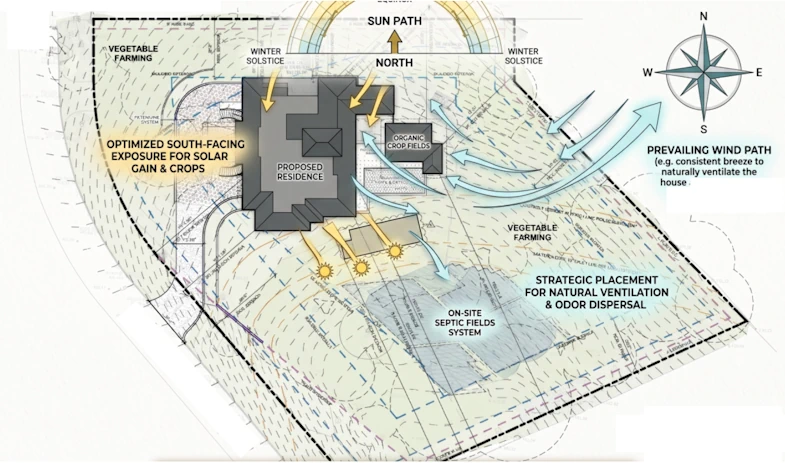
Most people see a plot of land. I see a finished home.
Not in a vague, intuitive way; in a very specific one. I'm looking at where the sun is at 8am
and where it will be at 4pm in December. I'm noticing which direction the wind comes from
and whether there are trees that will shade the lot in summer. I'm thinking about the slope
of the ground, where water moves when it rains, which corners of the site feel naturally
sheltered and which feel exposed. All of this before I've opened a sketchbook.
This is the part of the process that clients rarely see, and I think it's the most important part.
Because everything that comes after, every decision about where the front door goes, how
the living spaces orient, where the windows are placed should follow from what the site is
already telling you. A home that works with its land feels different from one that doesn't. You
can't always put your finger on why. But you feel it the moment you walk in.
I've visited sites in Los Altos Hills where the view is extraordinary but the prevailing wind
makes outdoor living uncomfortable for nine months of the year. The instinct is always to
chase the view. My job is to find a way to have both; to orient the home so the view is present
without the space being at the mercy of the weather. That's not always obvious from a set of
survey drawings. It becomes clear when you stand on the land at different times of day and
pay attention to what it's doing.
The site visit is not a formality. It's where the design actually begins.
I also look at the neighborhood, not just the immediate neighbors, but the character of the
street, the rhythm of the rooflines, the way houses relate to each other and to the road. A
home that feels right in its setting is one that has been designed with that setting in mind
from the very beginning. This doesn't mean every house should look the same. It means
every house should feel like it belongs where it is.
There's a particular kind of satisfaction that comes from a site that presents a real puzzle. At
times an awkward shape, a difficult slope, a heritage tree that has to be worked around.
These constraints, which can feel like problems at first, almost always lead to more
interesting architecture. The tree that forces you to shift the building footprint ends up
creating a courtyard nobody had imagined. The slope that seemed like a liability becomes
the reason the lower level has its own private garden. I've learned to be genuinely glad when
a site pushes back a little.
What I'm ultimately looking for, on every site visit, is how to bring the client's vision and the
land together. The ideas a client arrives with the images they've saved, the spaces they've
imagined, those matter enormously. My job is to take everything they want and find the
version of it that this particular piece of land makes possible. When those two things align,
the finished home feels right in a way that's hard to describe. Like it was always meant to be
exactly here.